
Translating research findings into effective public health interventions requires the active involvement of those who understand the challenges and needs of local communities.
As part of NeuroSolve’s efforts to develop context-specific and sustainable strategies for preventing Taenia solium infections, Richard Mambo (University of Zambia) recently led an online Community of Practice (CoP) session to introduce and test a participatory co-creation approach.
The session explored how findings from previous stakeholder mapping and implementation research can inform the collaborative development of practical prevention strategies tailored to the Zambian context.
Turning research findings into practical solutions
The co-creation approach builds on previous NeuroSolve research identifying key stakeholders and the barriers and facilitators influencing the implementation of Taenia solium prevention measures in Zambia. This includes stakeholder mapping research presented by R. Mambo at the European Congress on Tropical Medicine and International Health (ECTMIH) in 2025, which helped lay the groundwork for developing strategies that respond to local needs and priorities.
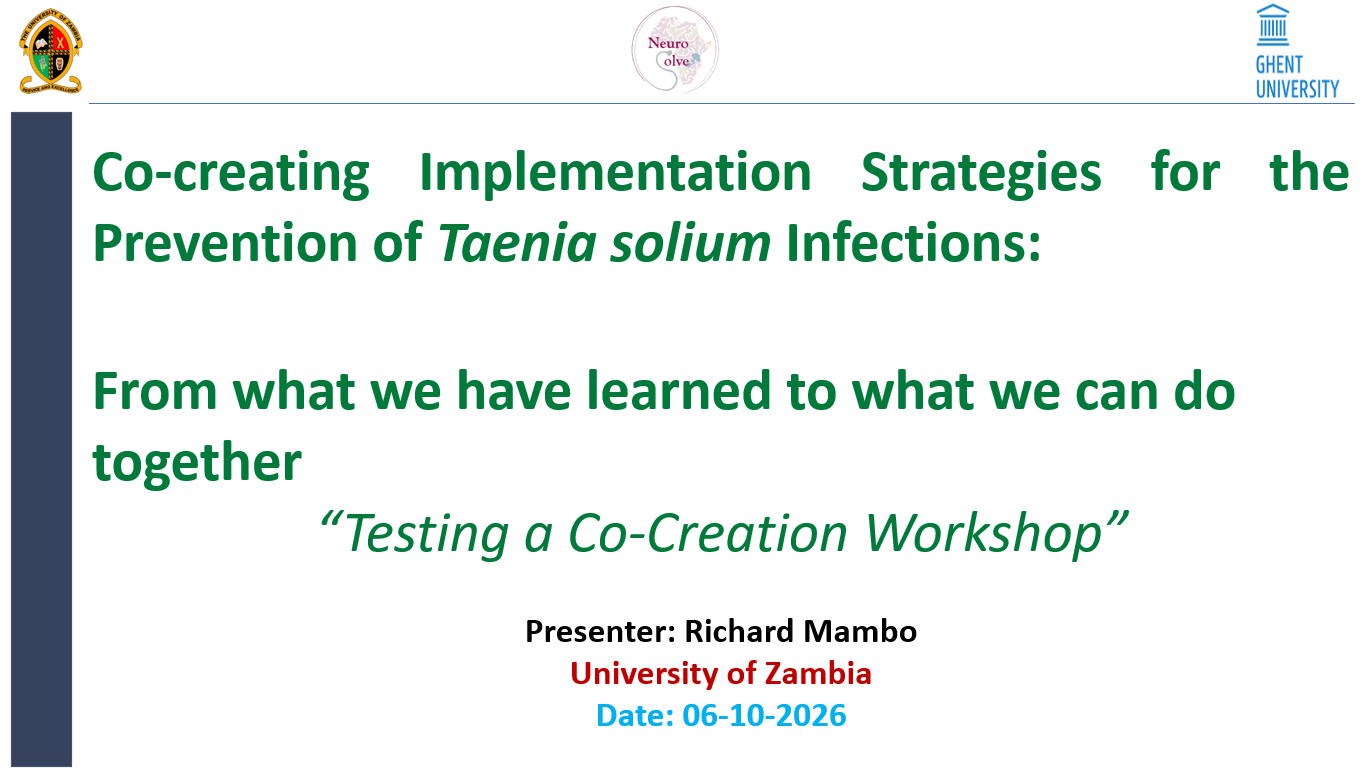
During the CoP session, Richard introduced a structured methodology to engage institutional and community-level stakeholders in identifying implementation challenges and developing potential solutions.
The approach combines insight statements to synthesise research findings, “How Might We” questions to stimulate collaborative problem-solving, participatory idea generation and prioritisation of potential solutions. It also incorporates Proctor’s strategy specification framework to support the development of clearly defined and actionable implementation strategies.
Testing participatory tools for community engagement
The session also provided an opportunity to test Mentimeter, a digital participatory tool, through interactive brainstorming on health education and latrine use, two important areas for preventing Taenia solium transmission.
CoP members tested the formulation of “How Might We” questions and the prioritisation of potential solutions, providing valuable feedback on the proposed methodology.
The discussion reinforced the importance of developing interventions that are evidence-based, feasible, acceptable and sustainable within existing community and institutional structures.
The feedback collected will help refine the methodology ahead of the planned stakeholder workshops in Zambia, where institutional and community actors will collaborate to develop prevention strategies grounded in local priorities.

Through this participatory approach, NeuroSolve continues to bridge the gap between research and practice, supporting the development of sustainable strategies for the prevention and control of Taenia solium infections and neurocysticercosis in sub-Saharan Africa.